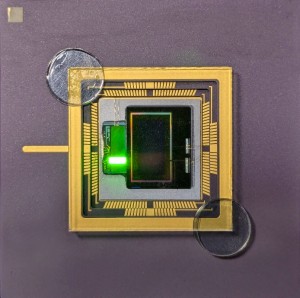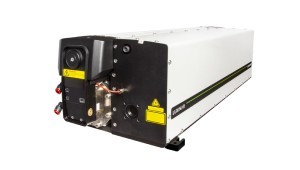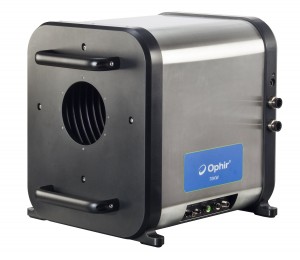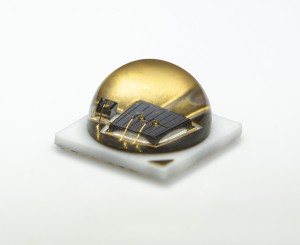








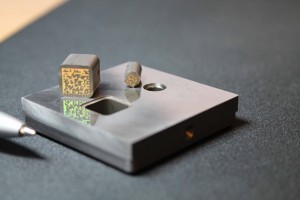



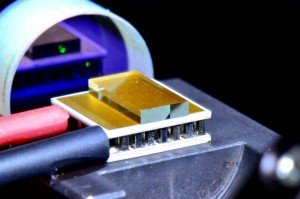
For the first time, researchers at Macquarie University in Sydney, Australia, have exploited optical interactions inside a synthetic diamond crystal to efficiently make high-power laser beams substantially brighter. In fact, the power density of the output beam exceeds that of the input beam, even though power is inevitably lost in the process. No other group has previously accomplished a net increase in laser beam brightness, let alone by 50%.
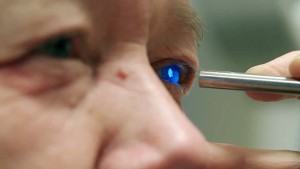
“In this work a poor quality laser beam — which is typical of many high power lasers — was converted to an ideal, diffraction-limited laser beam,” explains Dr Aaron McKay, postdoctoral research fellow at the Macquarie Photonics Research Centre and lead author of the paper “Simultaneous brightness enhancement and wavelength conversion to the eye-safe region in a high-power diamond Raman laser,” published in Laser and Photonics Reviews. “The wavelength of the poor-quality beam was also converted to the retina-safe spectral region, and as a result, this work demonstrated the brightest so-called eye-safe pulse laser to date.”
How is a net increase in laser beam brightness possible? “In our diamond Raman laser, photons from an external pump source are inelastically scattered in the diamond to a lower frequency, with some energy lost to heat,” explained the researcher. The scattered photons lase as a beam with a longer wavelength. What is more, this process also causes the converted beam to be ‘cleaned,’ according to McKay, who reminds that “brightness” in the context of lasers combines the beam quality of the laser (coherence) with optical power. “The brightness improvement that we have shown was only possible because of diamond’s excellent thermal properties and efficient operation.”
Diamond is significant in this research breakthrough mainly because of its superior ability to quickly conduct heat. “Without excellent thermal properties, strong thermal distortions, caused by the Raman scattering process, would lead to less brighter beams,” McKay said. Other materials have been tried in similar systems, but were limited to a few watts of optical power due to thermal effects.
McKay explained that enhancing the brightness of high-power laser beams is challenging and will become increasingly more important as power levels increase. “Our discovery demonstrated a method to improve the brightness of almost any laser beam,” he said. “Diamond’s incredibly high thermal conductivity and broad transparency combined with the Raman conversion process make this a widely applicable advancement for laser technology.”
Diamond could offer a unique approach to making high-power lasers currently already used in real-world applications a lot more brighter and convert their beams’ wavelengths to and eye-save range. “We see diamond-enhanced lasers as a means to improve the brightness of laser technologies used today in applications,” McKay said. “This includes environmental remote sensing, scanning lidar and laser range finding, by extending their range, sensitivity and access more eye-safe operation from mature laser platforms.”
McKay and his colleagues are now investigating the power limitations of their diamond lasers. “The power levels demonstrated in our recent work is only two or three times what has been demonstrated in other materials and, according to our calculations, is orders of magnitude below what we expect before thermal effects in diamond become significant.” They plan to investigate laser operation at much higher power and also want to investigate brightness enhancement in continuous-wave lasers.
Written by Sandra Henderson, Research Editor Novus Light Technologies Today
 Back to Features