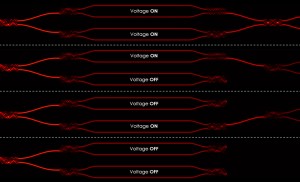








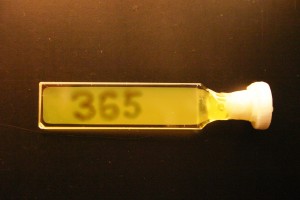
Researchers at the University of Helsinki, Finland, have created photochemically active polymers that dissolve in water or alcohols. Illuminating the photosensitive polymer in the cloudy solution with a nanolaser makes a clear trail of an ethanol-based dispersion visible as the azo compounds in the polymer chain switch between trans and cis conformation.
The goal of the study was to create a multi-stimuli responsive polymer (light, temperature and supramolecular activity) and then evaluate whether influencing one of the stimuli-responses would result in manipulation or control of the other stimuli-derived effects.
While light has previously been used to draw on solid surfaces (e.g., TV screens, LCD monitors), this is the first time researchers were able to use light to draw in liquids. “The polymer is a tegylated poly(azocalix[4]arene),” says doctoral student Szymon Wiktorowicz, who is credited with creating the polymer. “Chemically, it is a main chain azo polymer with calix[4]arene units that have been locked in the cone conformation with tetraethylene glycol monomethyl ether chains (TEGOMe).” This design translates to a threefold stimuli responsiveness: “The azo bridges account for the photoswitchability, the calixarene units are capable of host-guest interaction and the TEGOMe chains provide the thermo-responsive behaviour,” says the lead author of the article “Using Light To Tune Thermo-Responsive Behavior and Host–Guest Interactions in Tegylated Poly(azocalix[4]arene)s,” which appeared in the ACS publication Macromolecules.
Irradiating the polymers with a 365 nm laser leads to trans-to-cis photoisomerisation of the azo bridge, while a wavelength of 450 nm causes cis-to-trans photoisomerization. “The trans form of the system is preferred and the polymers can relax thermally back to that conformation,” Wiktorowicz says. “In the case of the tegylated, thermo-responsive polymers, irradiating the polymers in alcohols leads to a decrease in the cloud point (upper critical solution temperature), which is proportional to the trans/cis ratio present in the sample. This means that when the polymer is above the cloud point value, irradiation leads to a decrease in the cloud point temperature, and thus the polymer becomes soluble and the irradiated region transparent.”
The discovery could one day enable thinkable real-world applications. “The possibility to write on liquids seems appealing in terms of optical data storage and due to the supramolecular activity of these polymers,” Wiktorowicz explains. “These polymers also capture or release small molecules upon irradiation/thermal relaxation and different sensors and polymeric structures are being developed.” The expert says, ultimately the goal will be to develop smart coatings that can be manipulated into different functionalities through exposure to external stimuli.
This video showcases the study:
Wiktorowicz agrees that his breakthrough could help researchers develop new materials for optics and electronics: “From a basic research perspective, this particular study shows how important it is to consider the molecular design when dealing with a complicated structure,” he says. “It proves that when multiple stimuli-derived effects are present in a system, they may influence each other and create ways of controlling an outcome that would not be possible otherwise.”
Wiktorowicz is most excited about “the overall simplicity of the concept and how it translates to a clear, macroscopically visible effect,” he says. “Each chemical component serves its function and cooperates to produce exciting results.” In fact, he and his colleagues now want to “push the boundaries” by incorporating more stimuli-responses in the polymers and also explore other such ‘smart’ materials.
Written by Sandra Henderson, Research Editor, Novus Light Technologies Today
 Back to Features