









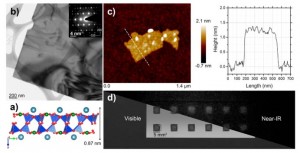
In a surprise discovery, researchers at the University of Georgia (UGA), Athens, Georgia (US), found that the calcium copper silicate in Egyptian blue — humanity's first artificial pigment, used in paintings on tombs and artifacts throughout the Mediterranean millennia ago — breaks apart into nanosheets so thin that thousands would fit across the width of a human hair. The sheets produce invisible infrared (IR) radiation that could lead to a new class of promising nanomaterials for state-of-the-art technochemical applications such as near-IR-based biomedical imaging, IR light-emitting devices (especially telecommunication platforms) and security ink formulations.
Egyptian blue is a mixture of calcium copper tetrasilicate, the active component of Egyptian blue, and other materials, mostly SiO2 in the forms of glass and quartz. “The bright blue pigment was the first synthetic pigment produced by people, so it represents a major milestone for human civilization and the development of chemistry,” says Tina T. Salguero, an assistant professor in the Department of Chemistry at UGA. Her team has discovered how to make nanosheets out of calcium copper tetrasilicate and has shown these near-IR emitters can be solution-processed by ink jet printing. Salguero is also a co-author of the article “Nanoscience of an Ancient Pigment” published in the Journal of the American Chemical Society.
“It's amazing that a layered material like calcium copper tetrasilicate can exfoliate, basically disintegrate, into its constituent layers just by stirring in hot water,” Salguero says. “And it's amazing that these single layers, each only about one nanometer thick, are stable enough to be isolated, characterised and processed.”
The UGA team believes the ancient pigment could be used in modern nanotechnology such as telecommunication devices, security inks to prevent the forgery of currency or certificates and for imaging through biological tissues. But there are other potential implications the discovery could have for future light-based technologies, too. “Egyptian blue is composed of abundant and inexpensive elements (calcium, copper, silicon, and oxygen), in contrast to other near infrared emitting materials that contain rare earth elements,” Salguero says. “This feature could provide economic and environmental benefits.”
Salguero and her team are currently working on additional processing and device fabrication possibilities and are also extending the chemistry to related materials, such as ABSi4O10, where A and B would be metals besides calcium and copper.
Written by Sandra Henderson, Research Editor, Novus Light Technologies Today.
 Back to Features