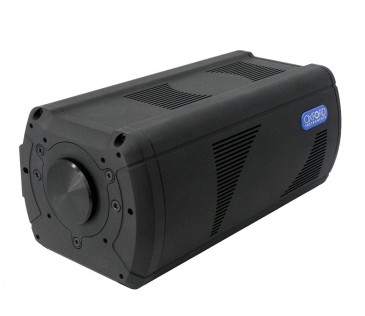












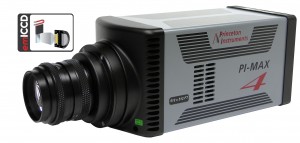
Princeton Instruments announced new emICCD technology, available in its PI-MAX 4 camera platform. Now one camera combines the advantages of intensifiers (i.e., ultrashort, subnanosecond exposure times) and the benefits of EMCCDs (i.e., linear gain and high quantum efficiency) to provide single-photon sensitivity and quantitative performance for scientific imaging and spectroscopy applications.
For more than three decades, Princeton Instruments ICCD cameras have been known for time-resolved imaging and spectroscopy applications. The company reports that the recently introduced PI-MAX4 series of cameras, for example, offers advanced capabilities such as <500 picosecond gating, very high repetition rates, RF modulation, and complete control via a truly revolutionary LightField software platform with an oscilloscope-like user interface.
Explained briefly, in an emICCD camera, either a back- or front-illuminated EMCCD is fiberoptically bonded to a “latest generation” intensifier with an S20/S25, GaAs, or GaAsP photocathode for the highest light throughput. By intelligently utilizing both the intensifier (i.e., MCP) gain and the EMCCD gain, the detector provides a larger dynamic range than that of an intensifier alone. This wider linear range of operation is very useful for quantitative measurements in comparing bright and dark scenes within a single image. The same camera can be operated at the highest system gain to detect single photons, overcoming the excess noise limitations of typical “gain” systems. New emICCD cameras also feature a built-in, fully calibrated, high-precision timing generator with 10 psec time resolution for external synchronization. These high-frame-rate (>30 fps) cameras can be operated remotely via a Gigabit Ethernet (GigE) data interface.
All PI-MAX4 cameras are fully supported by Princeton Instruments’ LightField 64-bit data acquisition software platform, which has been designed “from the ground up” for scientific imaging and spectroscopy. LightField provides a visual, interactive timing-setup interface that makes even the most complex synchronization experiments a breeze. The platform remembers each PI-MAX4 user’s hardware and software configurations and tailors its own features accordingly, displaying all relevant tools via an intuitive graphical user interface.
 Back to Products