










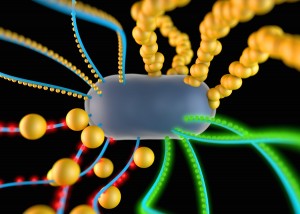
Researchers at the Massachusetts Institute of Technology (MIT) in the US have engineered living bacteria to organise gold nanoparticles and quantum dots into functional materials. The new hybrid materials combine the advantages of live cells with those of nonliving materials, which can conducting electricity or emitting light.
“This work establishes a proof-of-concept demonstrating the use of biology to control and pattern nonliving materials from the bottom up,” says Timothy Lu, an assistant professor of electrical engineering and biological engineering at MIT.
Living systems have the ability to sense their environment, adapt, self-heal and organise themselves from the bottom up across multiple length scales. Nonliving systems, such as modern materials, are not capable of doing that. Concludes Lu: “Thus, integrating living systems with non-living materials can yield the best of both worlds in terms of materials that are self-adapting, robust, environmentally friendly, healable and multifunctional.”
The goal of the current work was to demonstrate the potential for integrating synthetic biology and materials science to create new materials, but moving forward, the MIT team is thoroughly interested in investigating potential application of such living hybrid in structural materials, sensors, adhesives, stimuli-responsive devices, self-healing materials and adaptive materials, according to Lu.
Lu agrees this new approach to material synthesis could revolutionise the design of future solar cells and believes that “living cells could potentially be used to make solar cells or evolve materials for enhanced functional device performance.”
So how does this new method of material synthesis work? “We use the tools of synthetic biology to genetically engineer the bacteria such that they can be externally controlled and so that they can also interface with nanomaterials,” Lu explains. “These modified bacteria are grown with nanoparticles or chemical precursors to form hybrid materials that integrate living and nonliving components.”
The researchers chose the bacterium E. coli because it naturally produces biofilms that contain amyloid proteins that help E. coli attach to surfaces, called “curli fibres.” These curli fibres can be modified to capture nonliving materials, incorporating them into the biofilms whose properties can be controlled, e.g., to create gold nanowires, conducting biofilms, and films studded with quantum dots, or tiny crystals that exhibit quantum mechanical properties.
Another significant aspect of this research breakthrough is that these innovative hybrid cells communicate with each other. According to Lu, cell-to-cell communication, where cells transmit signals to each other, enables cellular communities to form dynamic and complex spatial patterns without any top-down control. “For example, our bones are formed by living cells that do not need any external instructions. Instead, our genetic code inherently contains the instructions needed to form complex structures,” the synthetic biology expert illustrates. “Thus, cell-to-cell communication can be used to grow novel functional materials from the ground-up with minimal need for external human intervention.”
Lu and his colleagues now hope to extend their work to create functional materials, explore the possibility of photosynthetic materials, synthesis platforms and develop systems that can be self-healing.
Their findings are detailed in the paper “Synthesis and patterning of tunable multiscale materials with engineered cells,” published in Nature Materials.
Written by Sandra Henderson, Research Editor Novus Light Technologies Today
 Back to Features