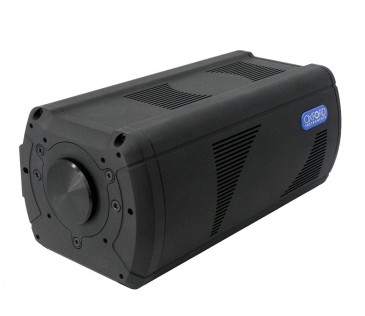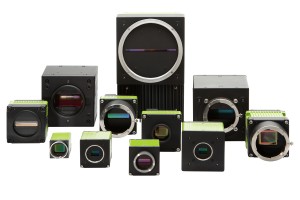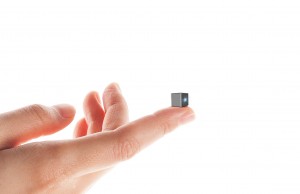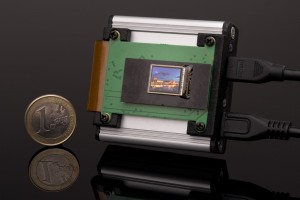










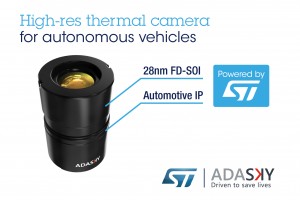
Global semiconductor maker STMicroelectronics and AdaSky, an Israeli-based startup bringing far-infrared (FIR) technology to the automotive market to enable vehicles of tomorrow to see further and better, have announced a collaboration, in which AdaSky’s FIR thermal camera embeds custom silicon co-designed with and manufactured by ST in its 28-nm FD-SOI manufacturing technology. The complete sensing solution from AdaSky, called Viper, aims to enable autonomous vehicles to see and understand the roads and their surroundings in any condition.
Complete sight and perception enables 24/7 autonomous driving
Having complete sight and perception of the roadway, other vehicles, roadside infrastructure and obstacles, especially in challenging lighting or weather conditions, is fundamental to the safe operation of next-generation autonomous cars. To achieve 24/7 autonomous driving, vehicles will rely on the fusion of complementary information streams provided by different sensors. No sensor or camera in operation today can capture all of the information on its own and each has challenges in certain lighting or weather conditions. Passive infrared vision, like that in AdaSky’s Viper, when used in a fusion solution, can help close the gaps to provide accurate sight and perception without fail in dynamic lighting conditions, in direct sunlight, in the face of oncoming headlights and in harsh weather.
FIR micro-bolometer sensor detects object’s temperature
The new camera uses an FIR micro-bolometer sensor to detect the temperature of an object. In an ADAS solution, Viper uses proprietary algorithms based on convolutional neural networks to classify obstacles and show them in a cockpit display to give the driver an early warning. This warning comes several seconds earlier than it would when using a conventional sensor in the visible wavelength and is even faster than what is possible with the human eye
Targeting 2020 production start
Viper has been designed in ST’s proprietary 28-nm FD-SOI manufacturing technology and uses ST IP that is fully qualified for automotive applications. Prototypes are under evaluation by carmakers, targeting a start of production in 2020.
 Back to Products