


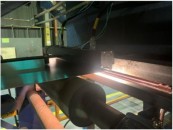






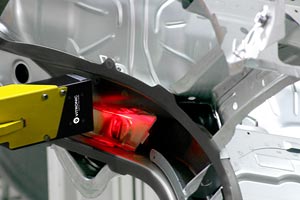
In contrast to manual inspection by trained employees, an automatic, optical inspection system always works objectively based on individual criteria – and is not influenced by employees having good or bad days. BMW Group uses weld seam inspection systems on many of its models. These systems use fully automatic monitoring to ensure that the required quality standards for welded seams are met. The welded seams on the rear part of the steel body have been inspected optically using the VIROwsi weld seam inspection system from VITRONIC since 2010. All inspection results are documented for future tracing. In addition, deviations in the welding processes can be detected and eliminated early, without having a negative impact on throughput, quality or production. The system consists of a sensor and a high-performance computer unit with evaluation software and a statistics function. It captures 3D data that can be used to derive a quality claim objectively based on the measured values. The measurement technology is based on the light sectioning principle. Typical scan speeds are between 100 and 200 mm/sec depending on the handling mechanism used.
The welded seams are inspected in the same production cell at the BMW Group's plant in Dingolfing/Germany immediately after metal active gas (MAG) welding is completed in order to inspect key seams that could be hidden during subsequent production processes and thus would no longer be accessible for inspection. The main chassis beam on the rear part consists of 12 welded seams, each 20-30 mm long, with six on the right and six on the left. Inspection takes place according to BMW Group specifications for welded seam length, seam surface, seam position, throat thickness, holes, undercuts and pores. To achieve this, a robot moves the main chassis beam along a stationary sensor so that all welded seams can be inspected. This inspection process takes 34 seconds. A challenge for the welded seam inspection software are the two parallel MAG welded seams, which are positioned very close to one another, since normally there is weld-free sheet metal to the left and right of the seam and the system must locate the edges of the welded seam easily.

The computer unit processes the weld seam images using evaluation software and depicts the inspection results visually on a customer terminal outside the production cell. Special software processes make it possible for welded seams that are close together to be inspected clearly and reliably. Information on the size and position of the defects is recorded in a protocol that can be used for tracing and process optimization. Defining individual warning limits, for example, allows drifting production processes and fluctuations in the product quality to be corrected quickly. All data generated is entered into a database and forms the basis for interactive statistics. Defect hot spots can be localized within the process using a defect frequency chart. This forms the basis for the systematic optimization of product quality. After inspection, the robot control receives a signal whether the inspection part is to remain in the production process or if it is to be redirected to a separate production cell for reworking.
Written by Andreas Breyer, Senior Editor, Novus Light Technologies Today
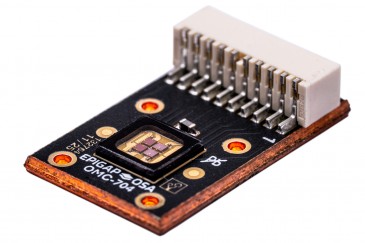
EPIGAP OSA Photonics GmbH, a leading global manufacturer and... Read More
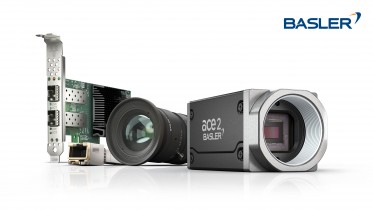
Basler offers a high-performance, compact, and scalable 10GigE vision system for data-intensive... Read More

For users focused on cost-effectiveness, InfraTec now offers cameras with predefined... Read More
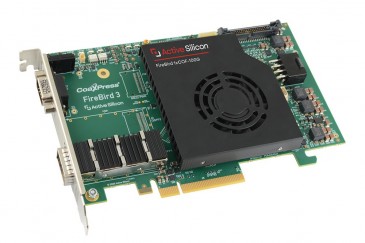
Active Silicon has launched the FireBird 1xCOF-100G, a... Read More

Torrent Photonics has launched SpectroCam 2™, a configurable... Read More
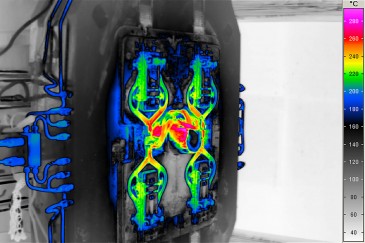
With InfraTec’s new DIECAST-CHECK automation solution, users... Read More
Basler AG, a leading provider of machine vision components and... Read More

Hamamatsu Photonics Europe is actively promoting Fairchild... Read More
As the global DRAM shortage enters a critical phase, driven by... Read More
Basler AG, a leading provider of machine vision products and... Read More
BitFlow, a world leading manufacturer of industrial frame grabbers... Read More
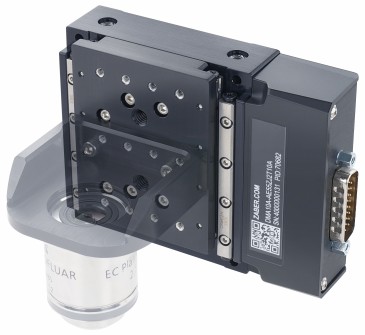
Zaber Technologies announces the DMA Objective Focus Stage, a... Read More