







Specialised Imaging's SIMD32 32-frame camera captures plasma jet dynamics at 33 million frames per second to help validate the next generation of fusion simulations.
Researchers in the Department of Physics at Imperial College London are using a Specialised Imaging SIMD32 ultra-high-speed framing camera to study how dense plasma jets interact with both magnetised and unmagnetised targets. Their results feed directly into the global effort to make fusion energy practical.
The camera was funded through the AMPLIFI Partnership, a UK consortium of academia and industry backed by EPSRC and First Light Fusion. The partnership is working on the hardest challenges in inertial fusion energy. Its long-term aim is a safe, secure and stable source of baseload power for the UK.
Smaller drivers, extreme conditions
Fusion requires extreme conditions. The partnership is investigating whether First Light's “Amplifier” technology can create them on far smaller and more cost-effective drivers than are usually proposed.
“Our research is focused on solving key scientific challenges of fusion energy,” said Simon Bland, Professor of Plasma Physics at Imperial College. “The Partnership is exploring the physics underlying First Light’s ‘Amplifier’ technology that could enable us to produce the extreme conditions required for fusion energy production on much smaller, cost-effective drivers than typically suggested. For this challenging application, the SIMD32 is the only framing camera capable of taking enough images at the speed and resolution we need.”
33 million frames per second, 32 images per shot
The plasma jets are produced by MAGPIE (Mega-Ampere Generator for Plasma Implosion Experiments) at Imperial College. For these experiments, the SIMD32 recorded at 33 million frames per second, which is roughly 30 nanoseconds between frames. At that rate, the fast-moving jets appear almost stationary in each image.
“The multiple frames of the SIMD32 enable us to explore both the production of shock waves as the jet reaches a target, and its dynamics later in time including the growth of any instabilities in the plasma,” Professor Bland explained. “This information is then used to help validate some of the world’s most advanced magnetohydrodynamic (MHD) simulations, enabling the Partnership to better model the behaviour of complex fusion targets.”
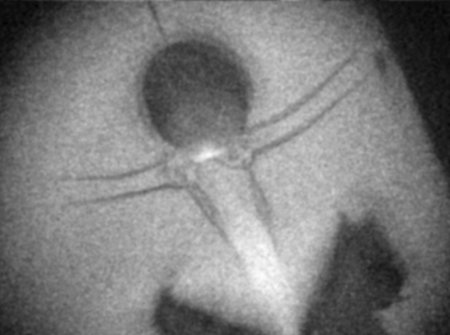
Image of a plasma jet interacting with a target. The system is schlieren imaged, with 30ns interframe and a pulsed power-driven dense plasma jet from the MAGPIE facility hitting the foam target and making an impressive bow shock.
In practice, each experiment gives the team a frame-by-frame record of the moment of impact and the evolution that follows. They can compare this record directly against their simulations.
About the SIMD32
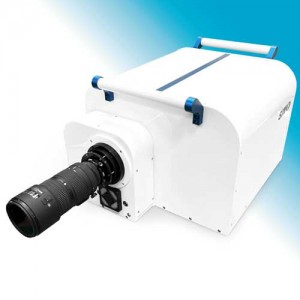
The SIMD32 is a double-shot, multichannel ultra-high-speed camera. It captures up to 32 images at up to 1 billion frames per second, with no shading or parallax between channels.
Highly accurate timing and fully flexible intensified CCD sensors give almost infinite control over interframe time, gain and exposure. This makes it possible to capture even the most difficult ultra-fast events. Triggering is fully adjustable, and a wide range of output signals is available. Custom software controls the camera and includes measurement and image enhancement functions.
More information
For more information about the Plasma Physics Research Group at Imperial College London, visit the Imperial College Plasma Physics Research Group website. To learn more about the consortium, visit the AMPLIFI Partnership website.
 Back to News