

















It’s all gone a bit quiet in the OLED lighting market. And it hasn’t gone unnoticed. In its latest report on the OLED lighting market, consultancy NanoMarkets points out that there have certainly been fewer announcements of great technical breakthroughs, projects, and the opening of manufacturing plants for OLED lighting in recent years. Most notably, little has been heard from GE, one of the biggest players in this market and the owner of a pilot line for OLED production. Some are concerned that the OLED industry is not managing to meet the technical challenges, while others believe it is simply because the companies made unrealistic promises.
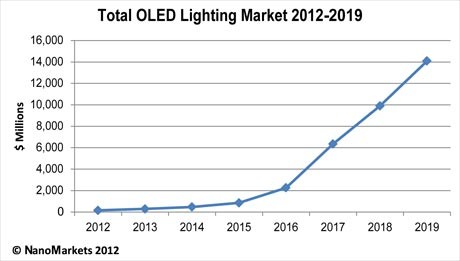
"There could be several explanations for this phenomenon," says Lawrence Gasman, principal analyst at NanoMarkets. "One is the generally poor state of the world economy. But we are not concerned. We have seen impressive improvements in efficiency in recent years and the size of OLED panels available is improving too. We are not pessimistic at all - we have seen this type of pattern in the evolution of a new technology before."
Some are concerned that the OLED industry is not managing to meet the technical challenges, while others believe it is simply because the companies made unrealistic promises.
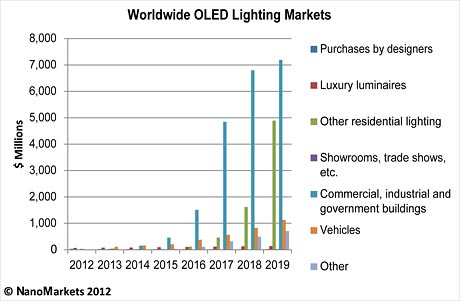
According to NanoMarkets, nearly 95% of the materials market in OLED lighting today goes into specialty OLED lighting applications such as designer kits, luxury luminaires, and high-profile installations. But by the end of the forecast period in 2019, 80% of the total USD2.8 billion OLED lighting materials market will go into residential and commercial general illumination applications.
Normal Bardsley of Bardsley Consulting is not yet convinced. He believes that OLEDs do not have much to offer over and above diffuse luminaires using LED technology and so they will struggle to establish themselves in mainstream markets. "OLED companies have been making exaggerated claims for many years and now those companies are struggling to fulfil these promises. Also, I am not sure there are many applications for which you cannot find an LED solution," says Bardsley. "OLEDs companies need to persuade people that there is added functionality or design that conventional LEDs cannot deliver."
This is just one of the many challenges that OLEDs face in this competitive market. As Bardsley points out: "OLEDs are currently much more expensive than LEDs; lifetimes are improving, but still not ideal; and the holy grail of printing OLEDs on plastic is still some way off due to issues with porosity of the encapsulant material. It was hoped that encapsulation technology developed for the organic solar cell industry would transfer to the OLED industry but the collapse of this sector has slowed down developments."
OLEDs also face competition from their inorganic cousins, the conventional LEDs. "LED technology can do most of what OLED technology has been promising for many years," says Bardsley.
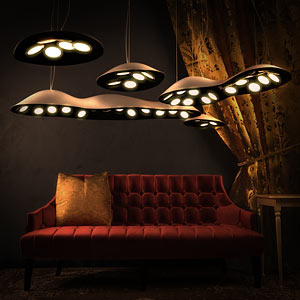 Bruno Dussert-Vidalet, founder of French company Astron Fiamm and its Blackbody brand, a specialist in OLED lighting design, disagrees. He told Novus Light Technologies Today: "LED light is ‘brutal’ whereas OLEDs provide smooth lighting that enhance the physiological comfort. Using OLEDs enables lighting designers to concentrate on light instead of designing a conventional lamp shade. OLEDs can be ‘painted’ in almost any shape and completely breaks the architecture of lamps. The shade is not necessary anymore. This opens a complete new field of products that will barely look like lamps."
Dussert-Vidalet believes that OLEDs will become a mainstream light source because "this is the only surface light source available today". He admits that the current cost of OLEDs is a stumbling block. "The OLED represents more than 50% of the lamp’s cost, this is mainly due to the maturity of the technology," says Dussert-Vidalet. "The main challenge is not technical; we have stabilized all necessary parameters to be able to produce with a very high quality and at a reasonable cost. The main challenge is to show the light to the market through installations where people can experiment with this new kind of light."
However, the widespread adoption of OLEDs depends on other lighting designers also using the technology. Not all lighting designers are convinced.
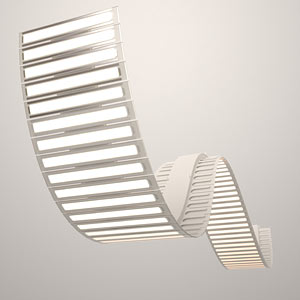
In a review of an event he attended two years ago, David Morgan, managing director of UK lighting design company DMA Design, called OLED light "rather boring and flat". Since then, his opinion has not changed. He said, "The OLED industry has made progress in the last two years, but not enough. The panels available to lighting designers need to be more efficient, longer lasting and lower cost. The major challenge is all the other types of LED light source which are improving at the same or a faster rate than OLEDs. If and when they are available in a flexible form, on a roll like wallpaper that would be interesting, but at the moment they are still too small, inflexible, inefficient, fairly short lived."
In a report published by the US Department of Energy, cost reduction was identified as one of the main areas the OLED industry needs to concentrate on. The report claims that there is a large opportunity for cost reduction in the deposition and patterning steps of OLED manufacturing. And it recommended that focus is also needed on equipment with lower capital cost and high volume production.
In addition to the manufacturing task recommendations, there were also a number of general recommendations pertaining to OLED manufacturing. These included OLED testing standards development; increased effort in product development and design of novel/breakthrough luminaires; identification of target markets for OLED entry to allow manufacturing costs to decline and ultimately pave the way to the general illumination market; and promote collaborative projects among US manufacturing lines and US companies that can make OLED substrates and materials.
Written by Nadya Anscombe, Contributing Editor, Novus Light Technologies Today
 Back to Features