






















It was a powerful message Basler AG, one of the largest producers of digital cameras for industrial applications worldwide, delivered a few days ago. Total sales of the company were reported to risen by 17% in the first nine months 2013; and with € 5.9 million earnings before taxes (EBT) have already exceeded 2012 pre-tax profit after nine months. The company counts on USB3 Vision as the coming camera interface technology for the mainstream and entry-level market segments it targets. Both achieved particularly good sales in Europe and North America, two regions, which at the moment, are not suspected to be the worlds’ economic drivers. Basler’s success indicates the potential for the European machine vision industry in the coming years.
Success story
Historically, the machine vision industry in Europe has been spoiled by double-digit growth rates for with exports as a main driver until the global recession in 2009, where its saw its first ever decline in sales numbers. Total turnover once again skyrocketed in 2010 by 35% pushed by catch-up investments after the crisis, followed by an almost 15% growth in 2011. Last year, total sales increased around 6%, approximately the level expected in the coming years by the European Machine Vision Association (EMVA). Gabriele Jansen, CEO of Vision Ventures and EMVA Board Member, expects that the EMVA 5% growth forecast from earlier this year will become reality in 2013, and sees a similar growth of European machine vision sales in 2014.
Despite a general slow-down of growth rates in Asian economies and in particular in China, the biggest growth impetus for the European machine vision players will still come from Asia according to the EMVA, in particular with the domestic European market being flat in 2013 and North America expecting even a slight decline. The strong export share to Asia is confirmed by ISRA Vision AG. The vision systems provider increased its revenues in the first nine months particularly in Asia and most notably in China. Here, as well as in Taiwan and Korea, first signs of a starting recovery for the photovoltaic industry are recorded by the company, shown by increasing inquiries for inspection solutions of upstream industries such as the module glass production.
Germany to share strong growth
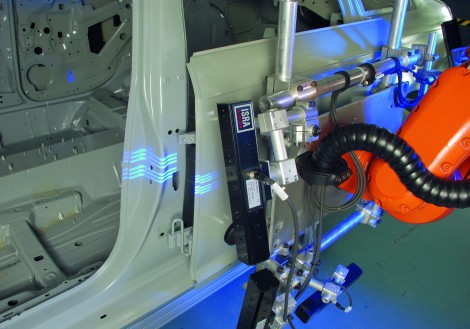
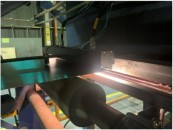
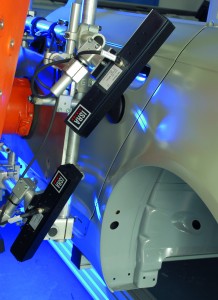
Despite the high number of degrees of freedom during assembly, the best-fit system allows precise fit of components according to target values. Photo courtesy of Isra Vision.
For the time being, the automotive industry still is the most important customer industry in Europe, mainly because it is so dominant in Germany, the main vision market on the continent. The German VDMA Machine Vision Group reports in its domestic machine vision survey a 21% share of the automotive industry of total sales of German vision suppliers in 2012, but also states that for the first time all non-manufacturing sectors taken together exceeded the sales share of automotive. Geographically, 55% of all sales in 2012 were realised abroad, with business to Asia going up by 13% compared to the year before. Exports to China even exceeded those to all other European countries for the first time ever. VDMA forecasts for the German vision companies an increase in turnover of 5% by the end of 2013.
Criminology and forensics, medical engineering, entertainment and new approaches to human-machine-interaction are areas where machine vision or image processing will make an increasing contribution in the future.
Looking into the future, EMVA Board Member Jansen expects the total industry in Europe to grow at single-digit numbers in the coming years. Market penetration has become high in traditional customer industries of machine vision technology. Despite that, she observes still huge unknown terrain that could become new customer industries, which might have been kept away from using vision solutions due to the high price tags attached to them. Criminology and forensics, medical engineering, entertainment and new approaches to human-machine-interaction are areas where machine vision or image processing will make an increasing contribution in the future. With compact systems and vision sensors becoming more and more powerful and affordable at the same time, these new customer segments could open up successively and then again deliver growth rates of 20% or more as a contribution to the more moderate overall growth.
Trends and challenges
Product-wise, the ongoing trend for simpler solutions and ease of use will last, also driven by more and more vision technology integrated into everyday products such as smart phones or video game consoles. 3D-technologies are still gaining importance mainly driven from the supplier side. A steadily growing demand for 3D technology is coming from the robotics industry, where 3D guided robots are more and more in demand. Plus, the market for robots is booming: According to the IFR Statistical Department, worldwide robot sales will increase by about 6%on average per year between 2014 and 2016. In 2016, the annual supply of industrial robots is expected to reach more than 190,000 units and companies such as KUKA, IBG Automation, Stäubli and Grenzebach will have their share of this number.
One challenge EMVA’s Gabriele Jansen sees for the European machine vision industry is an accelerating change in the current company landscape in Europe. This happens in terms of new entries of market players, be it from former customers that now operate their own vision department or from completely new players focusing mainly on non-industrial imaging applications. In addition, consolidation has gained momentum in the industry, driven by companies with a clear strategy to grow by acquisitions, but also by founders/owners of the pioneering generation who begin to think about retirement.
Overall, the European machine vision industry remains in good shape. In addition to automotive applications, where the technology first took hold three decades ago, the variety of applications is steadily growing, ranging from fish egg and fruit grading and sorting to 3D area mapping and goal line technology; with new application fields popping up almost every day.
Written by Andreas Breyer, Senior Editor, Novus Light Technologies Today
 Back to Features