













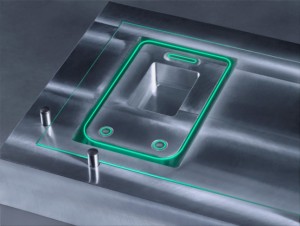
Ultrafast Pulsed Lasers are enabling new micro-processing applications as they do not deform material due to heat. These lasers are now becoming available on the market for industrial use. In emerging applications such as smart phone display and solar panel patterning the lasers are playing an important role in manufacturing today’s novel products.
The latest generation smart phones and tablets features touch screens made from chemically hardened glass, such as Corning Gorilla Glass, offering significant less scratching and breaking risk while windows becoming thinner and thus less heavy. As breakage of a glass window usually begins at micro cracks caused by the manufacturing process, better methods of edge- and feature cutting will thus directly upgrade smart phone user satisfaction.

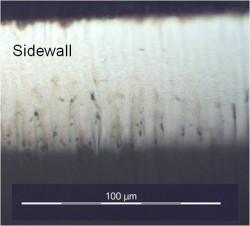
Established glass processing uses a combination of laser- and breaking techniques, which however, for hardened glass doesn’t work very well. The newest ultrafast picosecond pulsed DPSS lasers are able to cut through such glass panels completely, without cracking the glass. These lasers produce edge qualities more than 10x cleaner than established cutting processes using nanosecond lasers and can also perform curved cutting shapes and internal features.
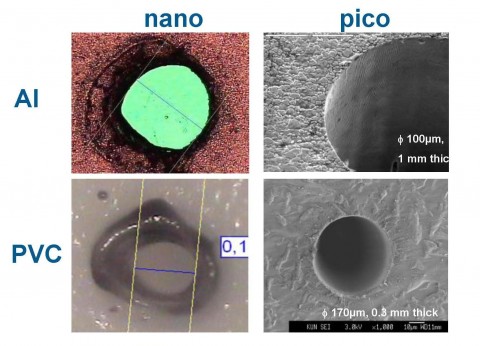
Picosecond versus nanosecond
The physics behind the ultrafast pulsed laser process is that pulses are so short that only material ablation by non-linear absorption takes place, where longer pulsed or CW lasers introduce thermal heat deforming cutting edges and inducing cracks and stress. Drawback of picosecond lasers is that they require up to 10x longer processing times.
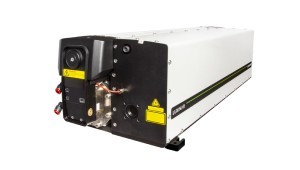
Trumpf explains: "Picosecond lasers like the TruMicro Series 5000 are ideal for cutting the glass plates. This technique avoids microcracks that appear when diamond saws or continuous or long-pulse lasers are used".

Picosecond lasers perform very well in various micromachining applications for medical implants and for aerospace, display, microelectronics and other industries. In photovoltaic applications picoseconds lasers enable solar panel efficiency enhancements both for silicium and thin film in for instance scribing and via hole drilling. The ablation process leads to extremely clean cuts and holes making additional processing steps such as de-burring and polishing unnecessary.
Picosecond laser architectures
Most currently available picosecond lasers are based on one of the following architectures: all-fiber (laser oscillator and amplifier), fiber laser oscillator and free-space amplifier or a DPSS laser oscillator followed by a free-space amplifier.
All-fiber is relatively low cost and robust; however, non-linearity and scattering in the fiber amplifier limit the maximum energy per pulse to about 10 µJ at 10 ps pulse width. Until recently, only increasing the repetition rate facilitates a high average power, but for this most galvanometer scanners are not fast enough to keep the individual pulses from overlapping at the work surface, thus limiting process throughput. However, Amplitude Systèmes has developed patented technology to overcome these drawbacks and for example its Tangerine femto-/picosecond fiber laser achieves both a high average power of 20 W, as well as high output energy of more than 100 µJ per pulse.
Another solution to achieve the higher pulse energies required for most applications, is using a free-space amplifier with a fiber laser oscillator. Coherent is making use of his approach in its Talisker laser that can produce pulse energies of up to 180 µJ (at 1064 nm and 200 kHz). Trumpf uses this technology but with a disc laser in its TruMicro series 5000.
The third approach is to use a DPSS oscillator, which can produce higher pulse energies than a fiber seed, followed by again a free-space amplifier, typically in either a regenerative or multi-pass configuration. It is even possible to use more than one amplifier stage to boost the power to higher levels. Lumera (now Coherent) picoseconds lasers are designed according this architecture featuring a Nd:YVO4 seed laser, followed by one or more transient amplifiers, enabling it to reach pulse energies as high as 200 µJ at 1064 nm.
Burst Mode
An important benefit of the transient amplifier is that it makes "Burst Mode" operation available in the Lumera lasers. In Burst Mode, a pulse picker passes a string of typically up to 10 pulses instead of just a single pulse and this entire pulse train is then amplified. Burst Mode is capable of, in some cases dramatically, increasing the ablation rate. Dirk Müller, Ph.D., Director of Product Line Management, Lumera Laser Technology,
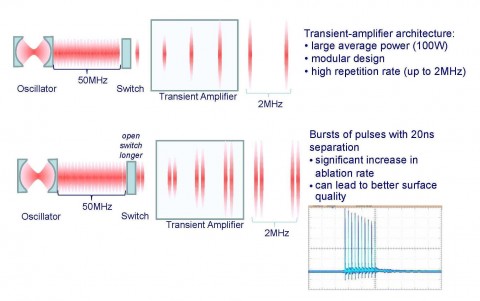
Coherent, says: "The exact mechanism for this is still being investigated, but there are some favored theories emerging. It is thought that when there are only 20 ns or so between pulses, the material doesn’t have time to relax, and remains in a "preconditioned" state. This allows for subsequent pulses in the burst to achieve greater material removal, despite their lower energy. Burst Mode expands the capabilities and opens up the parameter space of ultrafast micromachining substantially. It has proved most useful with materials having free electrons, such as steel, tungsten carbide and silicon."
Other manufacturers of industrial picosecond lasers include Eskpla, HighQ Laser (part of Newport/Spectra Physics) and Rofin.
Written by Robert Molenaar, European Editor, Novus Light Technologies Today
 Back to Features