






















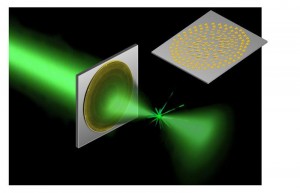
Applied physicists at the Harvard School of Engineering and Applied Sciences (SEAS) have created an ultrathin, flat lens that focuses light without the distortions of conventional lenses, as reported in the 15 August 2012 edition of the journal Nano Letters. It was reprinted in the 23 August 2012 edition of ScienceDaily.
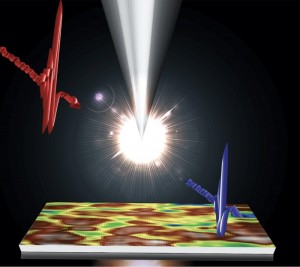
(Photo Credit: Artist’s rendition courtesy of Francesco Aieta, lead author of the paper.)
At 60 nanometres (nm) thick, the flat lens is essentially two-dimensional (2D) yet its focusing power approaches the ultimate physical limit set by the laws of diffraction. Operating at telecommunications wavelengths (i.e., the range commonly used in fibre-optic communications), the new device is completely scalable, from near-infrared (NIR) to terahertz (THz) wavelengths, and simple to manufacture.
According to principal investigator Federico Capasso, Robert L. Wallace professor of applied physics and Vinton Hayes senior research fellow in electrical engineering at SEAS, “Our flat lens opens up a new type of technology. We’re presenting a new way of making lenses. Instead of creating phase delays as light propagates through the thickness of the material, you can create an instantaneous phase shift … at the surface of the lens. It’s extremely exciting.”
The flat lens is created by plating a very thin wafer of silicon with a nanometre-thin layer of gold. When parts of the gold layer are stripped away, an array of V-shaped structures is left behind, evenly spaced in rows across the surface. When a laser gets into the act, these structures act as nanoantennas that capture the incoming light and hold onto it briefly before releasing it again. Those delays, which are precisely tuned across the surface of the lens, change the direction of the light like a thick glass lens would, with an important distinction: The flat lens eliminates optical aberrations, such as the “fish-eye” effect that results from conventional wide-angle lenses, astigmatism and coma aberrations.
The resulting image or signal is completely accurate and does not require any complex corrective techniques. The potential future would be to replace all the bulk components in most optical systems with flat surfaces.
 Back to News