


















Invisibility cloaks come in handy for fictional characters in movies, but the theory is very real and being advanced at the University of Central Florida.
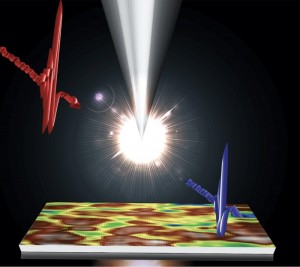
The theory is based on controlling and bending light around an object so it appears invisible to the naked eye. It is hard to create in real life because no material in nature has the properties necessary to bend light in that way. Scientists have managed to create artificial nanostructures that can do the job, called metamaterials. But the challenge has been making enough of the material to turn it into a practical reality.
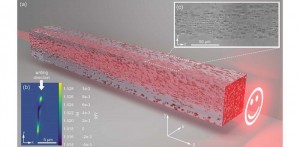
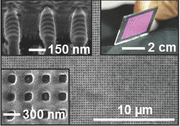
The work of Debashis Chanda at the University of Central Florida, described in a paper published the March edition of the journal Advanced Optical Materials, explains how Chanda and fellow optical and nanotech experts were able to develop a larger swath of multilayer 3D metamaterial operating in the visible spectral range. They accomplished this feat by using nanotransfer printing, which can potentially be engineered to modify surrounding refractive index needed for controlling propagation of light.
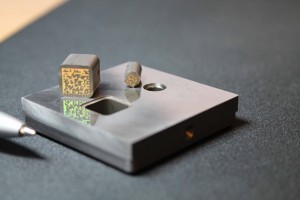
The nanotransfer printing technique creates metal/dielectric composite films, which are stacked together in a 3D architecture with nanoscale patterns for operation in the visible spectral range. Control of electromagnetic resonances over the 3D space by structural manipulation allows precise control over propagation of light. Following this technique, larger pieces of this special material can be created, which were previously limited to micron-scale size.
By improving the technique, the team hopes to be able to create larger pieces of the material with engineered optical properties, which would make it practical to produce for real-life device applications. For example, the team could develop large-area metamaterial absorbers, which would enable fighter jets to remain invisible from detection systems.
 Back to News