






-
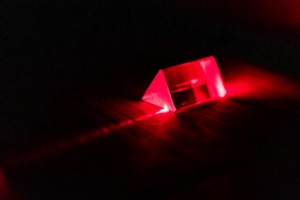
Letting Light Wander: ICTER's Surprising Approach to Better Imaging
Light scattered in tissue usually ceases to be a useful source of information. But what if, instead of forcing it to travel along a single path, we allowed it to wander a little differently each time? Scientists from ICTER... -

Nobel Prize is Awarded for Optogenetics
The Nobel Prize in Physiology or Medicine 2026 is awarded for optogenetics — a method that makes it possible to show how nerve cells shape memories, feelings and behaviours in the living brain. Peter Hegemann, at the... -
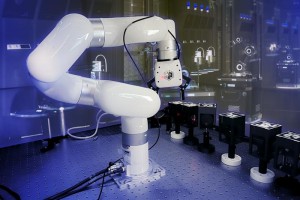
Robotic Lab Sets Up and Runs Optics Experiments on Demand
Every new generation of phone display, television screen, and solar panel is a result of precision optics experiments, which use lasers and other light sources to measure the optical properties of candidate materials. These... -
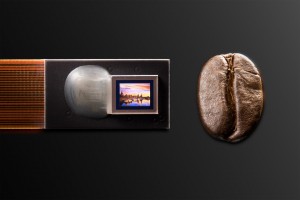
Full-Color RGBW Microdisplays: Next Generation for Brilliant, Energy-Efficient Visualization
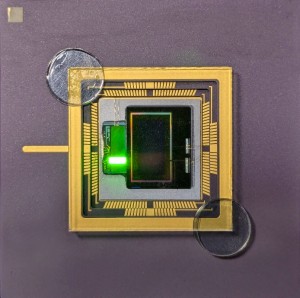
Scientists at the Fraunhofer Institute for Photonic Microsystems IPMS have developed a full-color OLED microdisplay based on a 28 nm CMOS process, which is highly efficient and features smallest pixels. The display will be... -
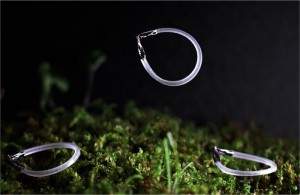
Light-powered Soft Robots Can Keep Jumping Forever
Researchers from North Carolina State University have created teardrop-shaped soft robots that leap upward or forward when exposed to infrared light – and will keep jumping as long as the light is present. The work... -
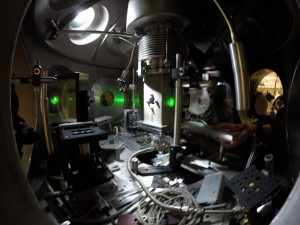
First Experimental Evidence Shows Strong Stellar Magnetic Fields Suppress CMEs
An international team of astrophysicists and plasma physicists has provided the first experimental evidence that strong magnetic fields surrounding active stars can completely suppress coronal mass ejections (CMEs), helping to... -
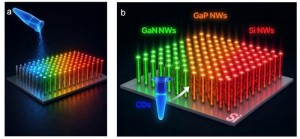
Host-engineered Carbon Dot Luminescence: Integration with Nanowires for Photonics
The integration of luminescent nanomaterials into scalable semiconductor platforms is vital for the future of on-chip photonics. Carbon dots (CDs) have emerged as a promising low-dimensional material platform, offering...
-
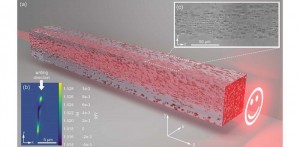
Ultrafast Laser Method Assists in Directing Light
Photonic technologies and applications often require light signals to be manipulated in three dimensions such as in optical computing, fiber imaging, data transport and quantum technologies. To be useful, the shape and direction of light must be... -
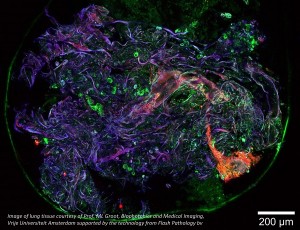
Sub-50 Femtosecond Pulse Lasers for Gentler Multiphoton Microscopy
Finding the ideal ultra-fast laser source for a multiphoton imaging setup is not trivial. It is a fine balance between peak power, pulse energy and laser wavelength. In this white paper we discuss important laser parameters and the impact these... -
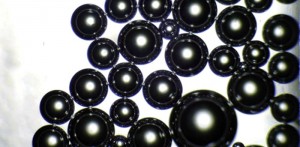
Optics Measure How Microplastics Hinder Light Flow in Our Oceans
Plastics have only been around since the 1950s and yet they’re everywhere: scattered in our lakes, rivers, floating on the top of oceans, and dropping to the bottom. Back in the 1950s and 60s, plastics were hailed as a useful invention, used... -
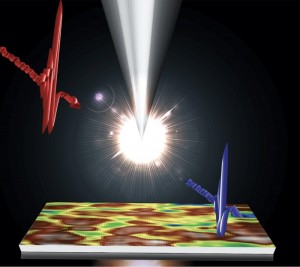
Terahertz Microscopy Explores New Material for Solar Cells
A team of scientists from the Department of Energy’s Ames National Laboratory gained insight into a possible alternative material for solar cells. The team, led by Jigang Wang, senior scientist from Ames Lab, developed a microscope that uses... -

Gaps noted in lung cancer diagnostics and treatment
Lung cancer is most common cancer in men and the 2nd most common cancer in women according to World Cancer Research Fund International. Lung cancer is the leading cause of cancer death overall and among both men and women, according to the American... -
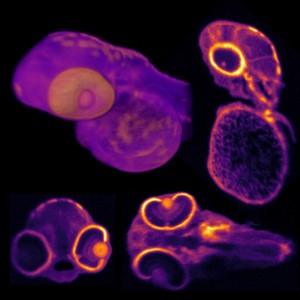
Advances in Optical Coherence Tomography
Optical coherence tomography (OCT) uses light for cross sectional imaging and is most commonly used for medical diagnostics, but it also has uses in applications such as analyzing paint on automobiles, nondestructive testing, and more. The global...