








Graphene was just the beginning. New research suggests there is a whole array of two-dimensional materials that could change many aspects of modern life. The latest discovery is the 2-D version of a material already used as an industrial lubricant, molybdenum disulfide — or MoS2. This new 2-D platform could pave the path for radically new products, from whole walls that glow to clothing with embedded electronics to glasses with built-in display screens.
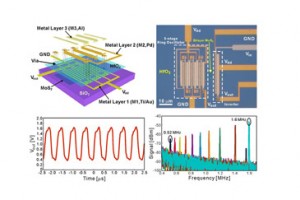
After struggling for years to build electronic circuits out of graphene, researchers at the Massachusetts Institute of Technology (MIT), Cambridge, Massachusetts (US), have already succeeded in making a variety of electronic components from MoS2, including complex electronic circuits. And there will be many more 2-D materials to follow, potentially ushering in a new era of electronics. Last year, MIT created the MIT Center for Graphene Devices and Systems to coordinate the work of more than 15 different groups actively researching novel 2-D materials throughout the Institute.
“Single-layer MoS2 is a semiconductor with a direct band gap, which gives this material excellent optical properties, such as extraordinary photoluminescence,” says Han Wang, graduate student in MIT’s Department of Electrical Engineering and Computer Science (EECS) and co-author of the report “Integrated Circuits Based on Bilayer MoS2 Transistors” published in Nano Letters. “The next step in MoS2-based optoelectronics technology is to demonstrate high performance LEDs and even lasers on such materials, which may later be integrated with the electronic circuits based on the same material to add the display functionality.” Furthermore, Wang believes it will be important to demonstrate the integration of MoS2 electronics with other large-area, low-cost light emitting materials, such as organic semiconductors. “By using MoS2 as driving circuits for organic LED (OLED), high-performance flexible displays may also be enabled,” he says. “MoS2 enables electronic systems based on 2-D material to handle both digital and analogue signals. With MoS2, any type of electronic systems we have today can now be constructed using 2-D materials.”
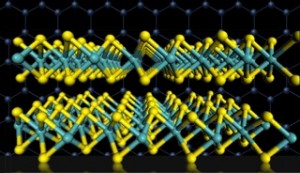
The diagram shows the layered, two-dimensional structure of molybdenum disulfide. Molybdenum atoms are shown in teal, and sulfur atoms in yellow. The background shows the crystal lattice of graphene
Potential game changer
The industry is actively looking for better alternatives to the driving circuits currently used for OLED, which are slow and inefficient. “MoS2 circuits can provide a faster and better performance solution for such applications.” As direct band gap material, single-layer MoS2 can potentially be a very efficient light detector and emitter itself.
Once Wang starts talking about potential applications enabled by MoS2 and other new 2-D materials, it quickly becomes apparent just how much of a game changer this technological advance could be regarding our daily lives. “A typical example is transparent and flexible electronics and displays. Displays can be integrated onto glasses to allow wearable screens. Cell phone can be transparent and bendable, and may be worn on the wrist. Newspapers can become fully electronic, but can still be folded, unlike the current iPad,” Wang enthuses. “All these devices can also have wireless access to the internet to allow interaction between each other and the rest of the world.”
It comes as no surprise then that the MIT researcher deems electronics at a historical crossroad. He identifies hybrid chips, which integrate various material systems on a single chip, as the first major evolution. “This may be the most fundamental change in wafer fabrication since the invention of integrated circuits almost fifty years ago,” Wang surmises. “Five decades ago, we started to integrate various electronic components onto the same chip, which changed the world. Today, we are starting to integrate various material systems onto the same chip. And that may change the world in the near future, too.”
The second revolutionary advancement is the shift of electronic system from 3D to 2D, enabling new forms of electronic circuits. One example could be so-called “ubiquitous electronics,” electronic systems that can be compatible with common commodities, such as plastics, paper and textiles. “The electronic system based on 2D material will no longer be restricted by the substrate wafer like in the Si technology. Instead, it can be built anywhere and at any scale.”
The potential impact on future light technologies could be far-reaching. “MIT demonstrated that any type of logic circuits can be constructed on MoS2,” Wang reiterates. “This technology can be immediately useful to fabricate driving circuits for organic LED displays, which may replace the existing technology that is very slow and requires high voltages. More importantly, our demonstration lays a platform for constructing any electronic circuits on MoS2 that can be much faster than circuits based on organic semiconductors and amorphous Si. These circuits may be placed on any substrates to build flexible and transparent display systems.”
Asked about his predictions for when and how the production of these two-dimensional high-performance materials will emerge on an industrial scale, Wang answers, “This will depend on the advancements in the large-scale growth of these 2D materials, which has seen significant progress in the past year here in Prof. Jing Kong’s group at MIT.” Presently, they can grow large-area single-layer MoS2 at inch-scale and transfer it to any substrates. “A lot of work is still needed, however, on the fronts of fundamental physics, material synthesis, device and circuit technology, as well as integration with other materials and technologies,” Wang says. “We are optimistic that industrial-scale application of these materials may emerge possibly in the next five years.”
Written by Sandra Henderson, Research Editor, Novus Light Technologies
 Back to Features