





Miniaturisation used to be an engineering ambition. Today it is an expectation. Whether we are talking about a wearable biosensor that disappears under clothing, an implant that delivers drugs precisely where they are needed, or a compact sensor buried deep inside a semiconductor tool, the brief is increasingly the same. More function, less space, zero compromise.
This shift is not just about shrinking what already exists. Miniaturisation is reshaping how we think about product development itself, from early concept decisions to validation, manufacturing, and lifecycle management. In my daily work with medical and high-tech OEMs, I see that the companies moving fastest are those that treat miniaturisation as a strategic design parameter, not a late-stage optimisation. And in that context, the choice of metal fabrication technology becomes central.
MINIATURISATION AS A SYSTEM-LEVEL CHALLENGE
The first misconception is that miniaturisation is only about component dimensions. In reality, it is a system-level challenge. Smaller devices must manage heat more intelligently, cope with higher power densities, handle more data, and still be robust enough for real-world use. For medical devices, add biocompatibility, sterilisation, and strict regulatory scrutiny.
These constraints often converge on the same critical elements. Thin metal parts that define flow paths in microfluidics, apertures in filters and stencils, contact geometries in connectors, or sharp profiles in needles and blades. At this scale, the metal component is no longer a commodity. It becomes a performance-defining feature.
WHY TRADITIONAL FABRICATION HITS A WALL
Punching, stamping and laser cutting have carried industry a long way. But as features shrink into the tens of microns and tolerances tighten, their limitations become evident. Mechanical processes introduce stress and distortion. Tool wear erodes repeatability. Burrs demand secondary finishing steps that are increasingly impractical when features are smaller than the abrasive media used to remove them.
Laser cutting, while flexible, brings its own challenges. Heat-affected zones, micro-cracks, changes in surface topography, and limits on how many identical parts can be produced before quality drifts. When you are designing a next-generation biosensor or high-frequency communication component, these small deviations can undermine an otherwise brilliant design.
In other words, innovation at the product level is frequently constrained by the physics and economics of conventional metalworking.
PHOTO-CHEMICAL ETCHING AS AN ENABLER, NOT AN ALTERNATIVE
Photo-chemical etching (PCE) enters the picture not simply as “another manufacturing option,” but as an enabler of a different design mindset. Because it is a mask-based, chemical process, PCE can create extremely fine features with no mechanical load and no thermal distortion. The material’s microstructure remains intact, surfaces are burr-free, and the process is inherently repeatable.
For engineers, this opens three important doors.
First, geometry is liberated. Apertures, channels, springs, flexures and complex outlines can be produced with the same precision, whether they are straight or highly intricate. Multi-level structures (for example, channel depths combined with surface textures) can be incorporated into a single part without additional tooling.
Second, iteration becomes economical. Because the “tooling” is a digitally generated photomask, design changes are implemented in data, not hardware. Early-stage trials and clinical feedback can feed directly into the next design without the time and cost penalties of re-machining tools. In medical development, where learning cycles are critical, this alone can compress timelines significantly.
Third, scalability is built in. The same PCE principles apply whether you are making dozens of prototypes on sheets or millions of parts via reel-to-reel processing. That continuity from concept to volume production reduces risk when a product finally moves into regulatory submission and commercialisation.
MINIATURISATION IN MEDICAL: BEYOND “SHARPER NEEDLES”
In the medical sector, miniaturisation is often discussed in terms of patient comfort, smaller incisions, less invasive procedures, more discreet wearables. These are important, but the real transformation is happening inside devices.
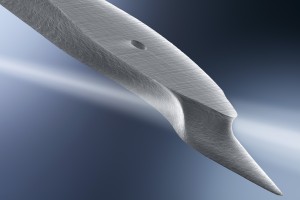
In micro-needle arrays, for example, tip radius, edge sharpness, and channel geometry all determine how drugs are delivered into the skin, how pain is perceived, and how consistent dosing can be. PCE allows us to form needle tips with extremely small radii, fine lateral features, and integrated fluidic channels , geometries that are extremely difficult or impossible to grind or machine repeatably, especially in very hard alloys.
Similarly, in implantable sensors and diagnostic cartridges, PCE is used to define flow paths, reaction chambers, and functional surfaces that influence how fluids wet, mix, and react. Because the process is burr-free and stress-free, these parts can be integrated directly into assemblies without polishing or deburring steps that might introduce contamination. For devices that must pass stringent biocompatibility and cleanliness standards, this is a powerful advantage.
What I find most interesting is how PCE enables new ideas. When designers realise they are no longer limited to simple holes and flat edges, they begin exploring asymmetric apertures, structured surfaces, and hybrid parts that combine mechanical and fluidic functions. Miniaturisation then becomes not only a way to shrink the device but a route to entirely new clinical workflows and business models.
HIGH-TECH SECTORS: PERFORMANCE PER CUBIC MILLIMETRE
In high-tech sectors such as semiconductor equipment, telecoms, and advanced sensing, the driver is often performance per cubic millimetre. Devices must operate at higher frequencies, withstand harsher environments, and integrate more functions into tighter spaces.
Here, PCE plays a similar enabling role, manufacturing thin, intricate metal parts for RF shielding, precision filters, thermal management plates, and high-density interconnects. At RF and mm-wave frequencies, for example, the exact form of an aperture or cavity has a measurable impact on signal behaviour. PCE’s ability to hold tight tolerances on thousands or millions of identical features allows designers to trust the correlation between simulation and reality.
In thermal management, etched channel structures in thin plates can be tuned for pressure drop and heat transfer without resorting to brazed assemblies or multi-part constructions. This simplifies validation and reduces potential failure points, crucial in systems where downtime is measured in eye-watering dollars per hour.
DESIGN COLLABORATION IS NO LONGER OPTIONAL
If there is one lesson I would emphasise to engineers exploring miniaturisation, it is this. Do not treat PCE (or any advanced process) as a late-stage sourcing choice. The full benefit appears when design teams and process experts collaborate from the outset.
Designing for PCE does not mean giving up creativity. It means understanding where the process works effortlessly and where small adjustments (such as minimum web widths, aspect ratios, or tolerances at part edges ) can dramatically improve yield and cost. When these discussions happen early, the result is often a better part and a more robust business case.
At Micro Component Group we see the most successful projects as those where product designers, materials specialists, and manufacturing engineers treat PCE as part of an integrated toolkit, not an isolated step. In many cases, PCE is combined with subsequent forming, plating, overmoulding or assembly operations to create complete sub-components. The common thread is that miniaturisation is approached as a system, not a collection of parts.
MINIATURISATION, SUSTAINABILITY, AND RESPONSIBLE INNOVATION
Finally, miniaturisation has a sustainability dimension that is sometimes overlooked. Smaller devices typically use less material and can be transported and packaged more efficiently. PCE contributes by being a relatively low-waste process, especially when used with reel-to-reel strip where material utilisation is high and scrap can be recycled.
But sustainability is also about making devices that perform reliably over their intended life, avoiding premature replacement and the environmental cost of failures. Precision, repeatability, and stable material properties are key here, all areas where PCE is strong because it avoids mechanical work hardening and thermal damage.
LOOKING AHEAD
Miniaturisation will continue to reshape product development in medical and high-tech sectors. The winners will not be those who merely make things smaller, but those who use the available manufacturing toolbox to rethink how products function, how patients experience therapy, and how systems deliver performance.
Photo-chemical etching is not the answer to every challenge, and it should not be treated as such. But it is a quietly transformative technology that aligns unusually well with the demands of miniaturisation: high precision, design freedom, repeatability, and scalability. When used thoughtfully (in partnership between OEMs and experienced manufacturing specialists) it does more than make parts. It makes new ideas viable.
That, ultimately, is where innovation happens.
Jochen Kern is Head of Sales & Marketing at Micro Component Group
 Back to Features