








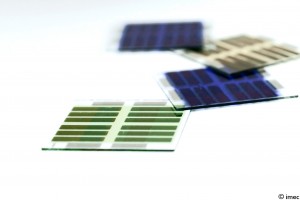
Organic solar is a topic of much interest because of their light weight, flexibility and low manufacturing costs. At IMOMEC, Imec’s associated lab at Hasselt University in Belgium, researchers have found that illumination stabilizes the morphology of polymer:fullerene bulk heterojunction (BHJ) solar cells that are exposed to elevated temperatures. The effect can be attributed to the light-induced dimerization of the fullerene. These new insights will likely contribute to further improvements in organic solar cells (OPV).
Increasing the lifetime and operational stability of the polymer:fullerene, BHJ solar cells have become a prerequisite for their successful commercialization. Elevated temperature and light are both crucial environmental stress parameters for the ageing of OPV devices. Thermal stress in dark conditions is known to induce an unwanted phase separation between the polymer and the fullerene, and thus results in an accelerated degradation. Imec has now demonstrated that light exposure during annealing slows this phase separation. These results lead to a better understanding of the long-term behavior of organic solar cells under operative and accelerated ageing conditions.
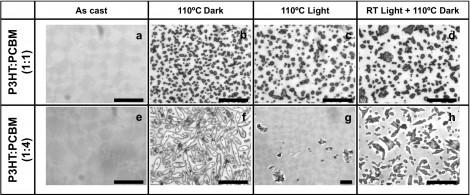
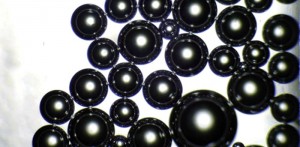
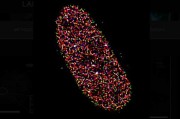
Optical reflection microscopy images of spin-cast P3HT:PCBM films in 1:1 and 1:4 stoichiometric ratio, exposed to various annealing conditions. (a,e) As cast films, (b,f) films annealed in dark for 62h at 110°C, (c,g) films illuminated during annealing at 110°C for 62 h, (d,h) films exposed to light at room temperature (RT) for 62h before annealing in dark at 110°C for 62h. The black bar in the optical microscope images corresponds to 20mm.
The combined effect of light and temperature was investigated on P3HT:PCBM BHJ solar cells. When annealed in dark at 110° for 62 hours, optical reflection microscopy images show a strong phase separation for P3HT:PCBM (1:4) cells. When the annealing is performed while simultaneously illuminating the films with white light, the phase separation is almost totally prevented. The morphology stabilization is less effective when the annealing temperature is increased to e.g., 150°C.
Light-induced dimerization
The observed effect is attributed to the light-induced dimerization of the fullerenes. The PCBM dimers have a reduced tendency to aggregate in crystalline clusters that slows down the temperature-induced phase separation. At higher temperatures, the dimers tend to dissociate, which explains why the morphology stabilization is less significant with increasing temperature. The morphological stabilization is not limited to P3HT:PCBM but is a general phenomenon in blends containing fullerenes.
These insights largely increase the understanding of the morphological degradation taking place under operative and accelerated ageing conditions. The observation of the improved morphological stability as result of exposure to light is an important achievement in view of the future commercialization of organic solar cells.
This research was financially supported by the European Union (the European Regional Development Fund - ERDF) in the frame of the project entitled ORGANEXT of the Operational Program INTERREG IV-A Euregio Meuse-Rhine.
This study has recently been published as a cover article in Journal of Polymer Science
Written by Forunato Piersimoni, IMOMEC based in Belgium
 Back to Features