









A new study reports a breakthrough metasurface-enabled terahertz (THz) imaging and spectroscopy platform that overcomes the limitations of the slow, sequential data acquisition process. Utilizing quasi-bound states in the continuum (q-BICs), the system enables ultrafast, nanosecond-scale image reconstruction with high accuracy. According to the authors, this compact, scalable, and circuit-free approach opens new possibilities for advanced sensing, high-resolution imaging, and next-generation photonic technologies across security, semiconductor, and pharmaceutical applications.
Terahertz (THz) radiation, characterized by low photon energy, ultra-broad bandwidth, and rich spectral fingerprint information, has demonstrated significant potential in applications, such as chemical identification, material characterization, security inspection, and high-speed wireless communications. In many of these applications, imaging plays a crucial role in revealing internal or surface features of objects that are otherwise invisible, including defect inspection in semiconductor devices and non-destructive detection of concealed contraband. However, owing to the lack of large-area detector arrays analogous to charge-coupled devices (CCDs) in the THz regime, existing THz imaging systems predominantly rely on raster scanning or computational imaging techniques, resulting in low imaging efficiency and limited real-time capability.
At present, high-performance THz detectors are typically bulky and expensive, which hinders their suitability for large-scale integration. Although computational imaging approaches can circumvent the need for large detector arrays by spatially modulating THz beams and reconstructing images using compressed sensing algorithms, these methods require the projection of a large number of modulation patterns and multiple iterative reconstruction processes. Consequently, the achievable imaging frame rate remains low, making real-time imaging challenging. Moreover, such approaches generally retrieve only limited intensity-based or binary information, while simultaneous access to intrinsic optical parameters of materials, such as dielectric constants or phase information, remains difficult.
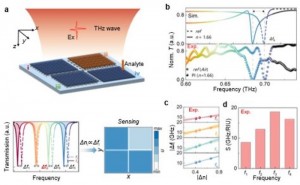
To address the aforementioned challenges, Associate Professor Longqing Cong from the Southern University of Science and Technology (SUSTech), in collaboration with a research team from Shanghai Jiao Tong University, proposed THz integrated sensing and imaging (ISAI) approach based on bound-state-in-the-continuum (BIC)–enabled pixelated metasurfaces. Using micro- and nanofabrication techniques, including heterogeneous integration and deep silicon etching, a 2 × 2 pixelated metasurface was fabricated. By exploiting high-Q, narrowband resonances supported by BICs, the pixelated metasurface establishes a deterministic mapping between the spatial positions of metapixels and their corresponding resonance frequencies.
Under illumination by a spatially structured THz field, characteristic signals of the imaging object are acquired within a single THz pulse. The entire imaging process is implemented in an all-optical and parallel manner, where object-induced variations in resonance intensity are directly mapped to spatial pixel information. This enables single-shot THz imaging without mechanical raster scanning or complex computational reconstruction. Meanwhile, the pixelated metasurface simultaneously functions as both a spatial and spectral modulator. By tracking resonance frequency shifts carrying spatially encoded information, the spatial distribution of the analyte refractive index can be retrieved using the same mechanism as imaging. In distributed sensing experiments, a refractive index resolution of 0.05 RIU was experimentally demonstrated.
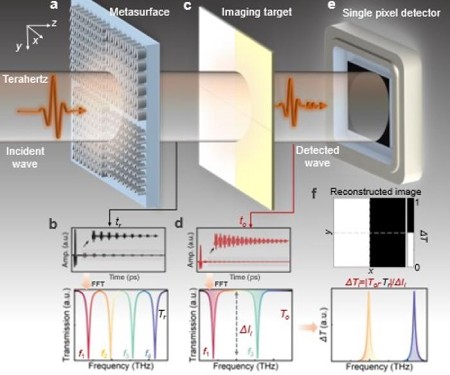
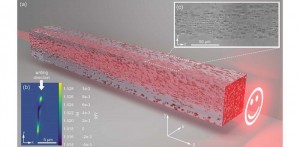
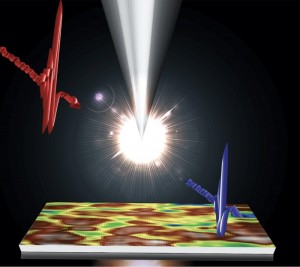
A novel parallelized terahertz (THz) single-pixel imaging approach replaces slow sequential compressed sensing by using a pixelated metasurface that operates efficiently within a standard THz time-domain spectroscopy system. The researchers report that this novel technology is able to achieve 100% accurate binary image reconstruction from a single THz pulse.
Credit: Longqing Cong from Southern University of Science and Technology, China
Conventional THz imaging techniques typically rely on algorithmic enhancement or deep learning and heavily depend on active hardware components, such as spatial light modulators or mechanical raster scanning, during image reconstruction. These active elements introduce additional instability and noise, while their sequential operation significantly increases acquisition time. In contrast, the proposed scheme integrates sensing and imaging into a compact platform fully compatible with commercial THz time-domain spectroscopy systems. The approach eliminates the need for high-power pump beams, complex optical paths, external driving electronics, or bulky mechanical components, thereby greatly simplifying the system architecture. In proof-of-concept experiments, the method achieved 100% accuracy in binary imaging, successfully reconstructed irregular concealed objects, and demonstrated a distributed sensing sensitivity exceeding 14.39 GHz/RIU. These results underscore the strong potential of this approach for real-time ISAI applications, particularly in next-generation security screening and quality inspection, where the non-destructive and penetrative properties of THz radiation can be fully exploited.
This work, entitled “Pixelated BIC metasurfaces for terahertz integrated sensing and imaging,” is published as a cover article in Opto-Electronic Advances in 2026.
Reference DOI: https://doi.org/10.29026/oea.2026.250211
 Back to News