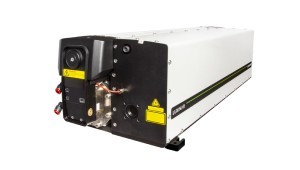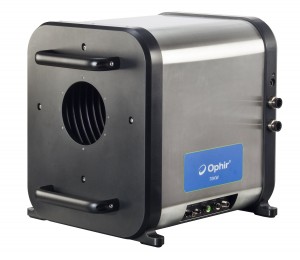











Many laser-based instruments in life sciences use fibre delivery of the laser beam, and instrument builders increasingly want to incorporate multiple laser wavelengths into their products. This can be achieved with custom designed modules, but these solutions are highly dedicated and not at all flexible. Indeed, the task of combining multiple lasers in single-mode fibre has represented a costly and complex optical engineering challenge for instrument builders, where even simple addition of just one laser requires system re-design. And, field-replacement (or “hot swapping”) is often far too difficult for the typical end user. Fortunately, a new type of laser combiner now brings true plug-and-play simplicity to this task, allowing lasers to be interchanged as easily as computer peripherals are connected with USB cables.
The need for multiple lasers
Numerous imaging or counting applications in life sciences are based on laser-excited fluorescence, a well-established technique that combines high specificity and high sensitivity. Here the biochemical entity, gene product, cell, or sub-cellular structure is tagged with a fluorophore that has a well characterized fluorescence emission spectrum. The sample is laser illuminated, and the resultant fluorescence is detected, thus enabling identification of the target.
The task of combining multiple lasers in single-mode fibre has represented a costly and complex optical engineering challenge for instrument builders.
In many of these applications, particularly flow cytometry, using multiple excitation wavelengths enables the use of a larger number of fluorophores. Each of these can be tagged to a different cell type, thus allowing simultaneous detection of several different targets.
Successful implementation requires lasers at the optimum absorption wavelengths for all the different fluorophores and a set of bandpass filters and photodetectors to uniquely determine which fluorophore is emitting a particular signal. For example, a “12 Color” system uses 12 photodetection bands, and perhaps five lasers, to detect 20 or more markers in a single sample run.
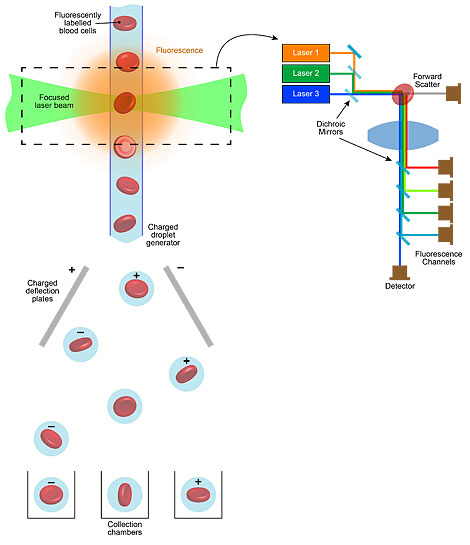
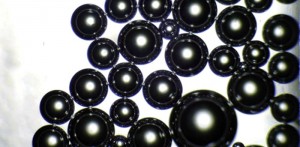
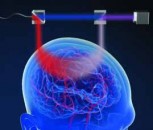
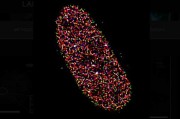
Figure 1. In flow cytometry, the use of several laser wavelengths enables multiple cell types to be counted simultaneously.
Challenges of combining lasers in single-mode fibres
Most applications require a high-quality laser beam that can be well collimated and focused to a small, symmetric spot. Where fibre delivery is required, this dictates the use of polarization-preserving, single-mode fibre, which has a core diameter of only 3.5 µm. Efficient coupling of a laser into this fibre necessitates optimization in up to six degrees of adjustment (x, y, z and three rotational angles). Moreover, these adjustments can drift over time due to thermal or mechanical effects, which is why permanently aligned pigtailed modules such as the OBIS FP series from Coherent have been an important advance for instrument builders.
Numerous imaging or counting applications in life sciences are based on laser-excited fluorescence.
In instruments with multiple lasers, fibre delivery not only removes the lasers from a potentially overcrowded interaction zone, it also ensures that each focused laser beam has an identical focused size and shape, no matter what the characteristics of the original laser beam (round, elliptical, astigmatic, etc.). However, the stringent opto-mechanical requirements for single-mode fibre beam coupling have traditionally made combining multiple fibre-coupled lasers a challenging task. Typically, it necessitated the cost and complexity of dichroic beamsplitters, polarizers and waveplates at each successive laser wavelength.
A turnkey optical bus for plug & play simplicity
In response to this situation, engineers at Coherent set out to design a flexible and robust “plug and play” combiner that preserves single-mode output and linear beam polarization, requires no mechanical adjustments whatsoever, and is completely passive, i.e., does not use any electronics. Another design goal was to use a minimum number of optics to maximize opto-mechanical stability and reduce overall cost.
A new type of laser combiner allows lasers to be interchanged as easily as computer peripherals are connected with USB cables.
The successful result of this effort is the OBIS Galaxy, which is the world’s first product to enable users to combine the output of up to eight separate lasers (spanning the 405 – 640 nm wavelength range) into a single mode fibre with simple plug and play connectors. The use of a novel fibre also avoids facet damage, a common cause of early failure in single-mode laser-fibre applications.
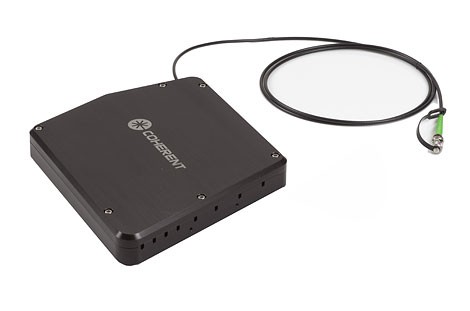
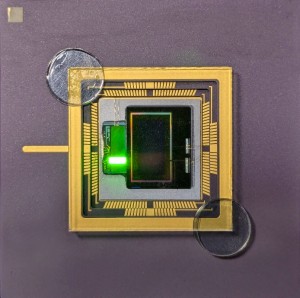
Figure 2. The OBIS Galaxy optical bus uses eight wavelength-dedicated plug & play input sockets to combine multiple lasers in a single output fibre.
How does it work? In OBIS Galaxy the wavelength-dedicated laser input sockets use the latest FC/UFC connectors that feature maximum optical registration precision. Each input is then collimated as a macroscopic beam using a rigidly mounted lens. But, instead of the multiple optics used in many custom systems, this new optical bus uses a patent-pending design to combine all the separate wavelengths into one output beam.
Extensive stress testing of this new beam combiner confirms the validity of this rugged approach. For example, it has a wide operational temperature range, spanning 10 - 40°C. And, repetitive testing proves that lasers can be effortlessly replaced at any of the inputs, with less than a 5% change in power at the output fibre. Designed as a flexible and open-architecture platform; this laser supports both direct plug-and-play with OBIS FP smart laser modules, as well as visible lasers from other manufacturers that comply with the beam combiner input specification via an optional (FC APC-UFC) cable.
Written by Dan Callen, Product Line Manager; Michael Winz, Manager of Photonics Engineering; and Matthias Schulze, Director of Marketing in the Life Sciences at Coherent Inc.
 Back to Features